 SuperQode
THE HARNESS INTEROPERABILITY LAYER
HARNESSLAYERfor coding agents
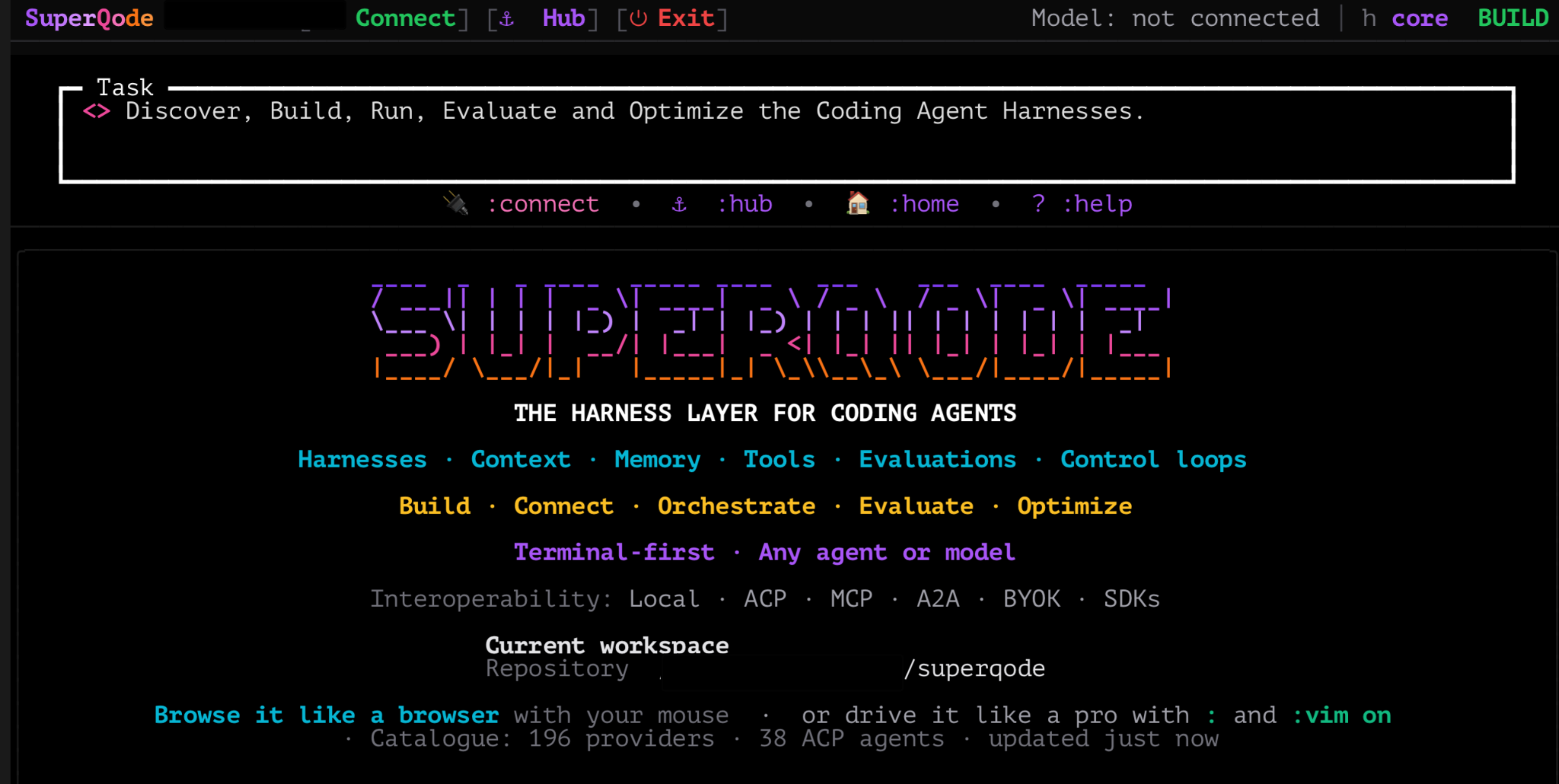
Discover, build, run, evaluate and optimize coding-agent harnesses.Interoperable across ACP, A2A, MCP and UHP.Make smarter decisions with the Jev-powered SystemOne Harness.
Coding agents do not talk to each other. Yours will.
Jev SystemOne Harness
The dedicated harness for SystemOne models
DEMO
Watch the demo
The terminal, the Hub and the A2A agent, end to end.
One session: connect an agent, browse the Hub, and call the A2A agent from the same terminal.
Watch on YouTube →SYSTEMONE HARNESS · TUNE
Smart decisions with Jev, taught from your examples
Coding models keep writing code. SystemOne handles bounded judgments with Jev. Tune starts from unlabeled examples, asks for human review where it matters, and stages an experimental decision pack without changing your active harness.
Jev Integration ↗
Connect Jev inside the SystemOne harness. Coding models keep writing code; Jev answers Choice, Score and Noul questions that policy can inspect.
Progressive tool discovery ↗
Catalogue, search, rank, then let Jev activate a schema. Optional tools stay out of every prompt until selected.
SystemOne Tune (GEPA) ↗
Start from an unlabeled pool. Jev ranks uncertain examples, you review a small batch, and Tune stages an experimental pack without changing the active harness.
Docs: Integration · Discovery · Tune. Live Jev calls need TYPESAFE_API_KEY.
LIVE · JEV TOOL ROUTING
Send the model the tools this turn needs
Jev scores a closed set of tool choices once per turn. SuperQode holds the selected catalogue stable across every model step, preserving prompt-cache reuse while reducing repeated tool-schema context.
The six launch profiles include Codex, whose subscription catalogue is injected server-side and is reported as gateway-limited. Antigravity is detected and reported until its CLI exposes a model endpoint hook.
Local launchers
OpenCode, Claude Code, Grok Build and Pi run through process-local adapters. Native SuperQode uses the router directly.
No persistent harness configuration is rewritten.
One routing core
The Python SDK, OpenAI and Anthropic gateway, native Gemini path, HTTP API and MCP server share one implementation.
One decision contract across every integration surface.
Conservative controls
Core workspace tools stay available. Errors, timeouts and incomplete answers return the full catalogue.
Start in shadow mode, inspect evidence, then enable enforcement.
jev.superqode.dev
The authenticated Cloud Run service exposes POST /v1/route-tools and Streamable HTTP MCP at /mcp. A stable turn_id reuses the decision for later steps.
FOUR DOORS
The same product, four ways in
TUI and CLI first. A2A when another agent should call you.
LIVE · AGENT2AGENT
Be called as an agent
Published at a2a.superqode.dev, callable by any A2A client, and no repository leaves your machine.
On the JSON-RPC and HTTP+JSON transports the Agent Card declares. Reproducing the run is in the A2A guide. Third-party and CI clients can use the official a2a CLI.
Published Agent Card
Fetch it, pick a binding, send a task. Signed API keys gate access when you need it.
LIVE · UNIFIED HARNESS PROTOCOL
Be driven as a harness
Published at uhp.superqode.dev and callable by any UHP client. One configured HarnessSpec on the wire, not a wrapper around someone else’s CLI.
Measured with the published conformance suite, which is what the specification says a conformance claim means. A skip is never a pass, so a run with none is the only kind worth publishing.
Anonymous capability document
Read what the host serves before presenting any credential. Running a task needs a bearer and your own provider key.
INTEROPERABILITY
Speaks every protocol
Most tools speak one protocol and call it an ecosystem.
Publish a card. Gemini Enterprise, Foundry and AgentCore can call you.
Every agent in the official registry, from the same terminal.
Tool servers attach to a harness under the same permissions.
One portable description of the loop, so a spec travels.
CODING AGENT
Use as a coding agent
Connect the agents you already use, in four ways.
SuperQode is a coding agent in its own right, in the terminal and from the CLI. Every model provider, every memory backend and every search route is reachable from the same session, so you are not choosing a vendor when you choose an agent.
Every model
45 providers in the built-in registry, hosted on your own key or local on your own machine.
Anthropic · OpenAI · Google · xAI · Meta · NVIDIA · Ollama · LM Studio · MLX · vLLM · SGLang · TGI · llama.cpp
BYOK and local providers →Harness memory
Facts, preferences and project context that survive the session.
local files · specmem · mem0 · cognee · supermemory
Memory providers →Search that finds intent
Exact text, symbol names, and meaning, across one repository or many.
grep · code_search · semantic search · multi repo · offline indexes
Semantic code search →FOUR WAYS TO CONNECT AN AGENT
 Codex
Codex Claude
 Copilot
 Antigravity
 Grok
Grok Prime Agent
 Muse Code
 Kimi
Kimi GLM
GLMPlus 45 model providers, hosted and local. Providers docs →
Sign in with a plan you already pay for.
Codex · Claude · Copilot · Cursor · Grok · Muse Code · Prime Agent · Antigravity
Any ACP agent, driven from the same terminal.
OpenCode · Cline · OpenHands · Kimi Code · Qwen Code · Amp · Devin · Factory
OSI licensed harnesses on your own key or a local model.
Tau · OpenCode · DeepSeek Harness · Cline · OpenHands · Letta Code
Proprietary harnesses on that vendor key.
Factory Droid · Junie · Muse Code · Qoder CLI


OPTIMIZATION
Measure, then improve
Optimization never edits the live spec.
Candidates stay reviewable artifacts gated by repository tasks. You promote explicitly.
RELEASE EVIDENCE
Write the decision down
Evaluation says how a harness scored. A record says what shipped, and why.
`sq gauge` emits an Agent Quality Record: what was measured, which conditions had to hold, whether they held, who accepted the result, and the version to revert to. It computes nothing new, projecting the eval result, execution policy, governance decisions and promotion ledger SuperQode already holds.
The format is an open specification any tool may implement. github.com/SuperagenticAI/supergauge
THE PROBLEM
The gap
Coding agents alone do not create a dependable code factory.
Every agent keeps its own context, tools, permissions and evidence. SuperQode puts one lifecycle across them.
HARNESS OWNERSHIP
Own the loop
Model + Harness + Memory + Governance
Configuration, context, memory, tools, policy and evaluation criteria, in a versioned HarnessSpec beside your code.
- Portable across Codex, Claude, Copilot, and local models
- Inspectable policy for tools, sandbox, and approvals
- Same evidence graph regardless of runtime
Benchmark the product you rely on against a controlled alternative, on your own repository.
Build a harness →LIFECYCLE
One event graph
Build, run, evaluate, govern, optimize, record.
CAPABILITIES
The full surface
Everything needed to run the factory.
Remote control, sessions, safety policy, recursive models and the rest are documented in full. CLI reference →
HARNESS HUB
72 harnesses
Find the right harness for the job.
Coding agents, ACP routes, native harnesses and model presets, with runtime, setup, provenance and licence on every entry. Browsable here or in the terminal with :hub.
SUPERQODE HARNESSES
START HERE
Get started
Install, open a repo, start.
Everything after this runs from the TUI or the CLI. The short alias sq runs every superqode command.
Already have uv? uv tool install superqode or uvx superqode
Remove any time: uv tool uninstall superqode
Switch harnesses mid session, fork attempts, export session evidence. Headless and CI use the same spec. Omnigent specs import as HarnessSpecs.
Omnigent docs →DESIGN PARTNERS
Measure the spend
Coding agent budgets are set on a demo and a feeling.
We are looking for a small number of teams to benchmark candidate harnesses on their own repositories, and to find where the spend actually goes.
FAQ
Questions
Installation, providers, the HarnessSpec schema and the full CLI are in the docs. Read the documentation →
SuperQode is built and maintained by Superagentic AI. We also work with teams directly on agent experience, engineering, optimization and delivery. See how we work with teams →
Versioned with your code
Build harnesses you own, or connect the agents you already use, then measure how they work.
OPEN SOURCE · TERMINAL FIRST · ANY AGENT OR MODEL · LOCAL OR CLOUD